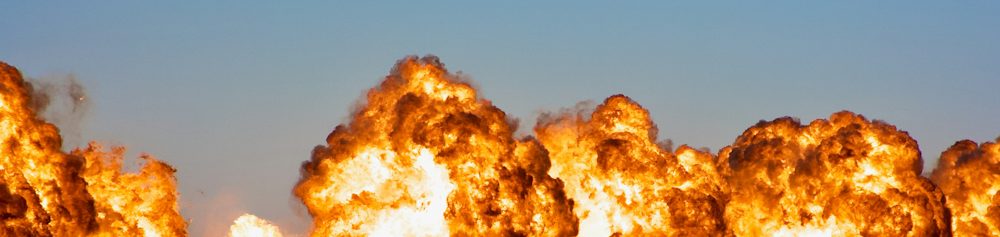
Dust Explosion

To prevent serious damage, understand and prepare for dust explosions.

Dust explosions are extremely powerful and can instantly collapse buildings and cause numerous injuries. For this reason, measures to prevent dust explosions are extremely important in factories and other facilities. In this article, we will explain the causes of dust explosions as well as measures to prevent them from occurring.


What is a dust explosion?

A dust explosion occurs when combustible dust particles, such as metal powder, coal dust, or flour, become airborne and ignite, causing an explosion. When thermal energy is applied to airborne dust particles, their surface temperature rises, causing them to ignite, spreading the heat to other particles in a chain reaction, ultimately resulting in an explosion. While small-scale explosions, such as those conducted in science classrooms using flour as a "dust explosion experiment," can easily escalate into large-scale explosions, which is frightening. Recently, a large-scale explosion occurred at a music event at the Ba Xian Water Park in Taiwan, resulting from the use of colored powder containing flammable substances, resulting in approximately 500 injuries and 15 deaths. Furthermore, if flour, a common daily commodity, is accidentally scattered into the air and ignites, a large-scale dust explosion can occur. So, what conditions are necessary for a dust explosion to occur?


Three conditions for a dust explosion

Dust explosions, which have the potential to cause great tragedies, occur when three conditions are met. These conditions are oxygen, combustible dust at or above the lower explosive limit, and an ignition source with a minimum ignition energy. Each of these conditions is explained below.

oxygen

The first condition is oxygen. The explosiveness of powder is closely related to the oxygen concentration known as the dust explosion limit, and a dust explosion occurs when the oxygen concentration exceeds the dust explosion limit. Most organic dusts will not explode if the oxygen concentration is below 12-13%. However, in the case of special materials such as fine organic powders or metal powders, an oxygen concentration of just a few percent can cause an explosion. Dust is very fine to begin with, and the ratio of surface area to volume of the material is very large, so the dust is surrounded by plenty of oxygen. Therefore, dust itself can be said to be highly flammable.


Combustible dust exceeding the lower explosive limit

The second condition is that the dust is "combustible dust at or above the lower explosive limit." If the dust concentration exceeds the lower explosive limit and also meets the other two "three conditions for a dust explosion," there is an extremely high risk of a dust explosion. This lower explosive limit is generally determined using a method known as the blow-up method. The powder is dispersed in a container using compressed air, and an investigation is conducted to determine whether an explosion occurs due to an electric spark. The concentration at which a dust explosion no longer occurs is defined as the lower explosive limit, and oxygen concentration is controlled based on this value.


Ignition source with minimum ignition energy or higher

The third condition is "an ignition source with a minimum ignition energy or higher." Minimum ignition energy refers to the minimum energy required to ignite dust, and is a standard for the risk of ignition due to static electricity. The region where a dust explosion does not occur because this energy is low or the dust concentration is not at a value that would lead to a dust explosion is called the "non-explosive region." Conversely, the region where a dust explosion is triggered due to the relationship between ignition energy and dust concentration is called the "explosive region." If this minimum ignition energy exceeds the "explosive region," a dust explosion will occur.


How to prevent dust explosions?

As mentioned above, dust explosions occur when three conditions are met: oxygen, combustible dust at or above the lower explosive limit, and an ignition source with a minimum ignition energy level. However, if even one of these conditions can be reduced, the explosion will not occur. In addition to managing to reduce oxygen concentration and ignition sources to more reliably prevent explosions, it is also necessary to understand which types of dust pose a high risk and establish a thorough management system. Here, we will introduce some measures that can be taken to prevent accidents.

Thorough dust management

First of all, it is important to reduce the probability of a dust explosion through thorough dust management in order to prevent an explosion due to human error. For example, make sure to thoroughly seal containers used when handling dust. Sealed containers that handle dust will prevent the supply of oxygen necessary for a dust explosion. If dust leaks from a container, clean it up quickly. Also, when handling powder in factories, etc., take measures such as installing dust collectors and frequently cleaning and ventilating the area.


Identifying potential hazards of dust

It is also necessary to thoroughly check the potential dangers of dust. In particular, when using industrial equipment, it is essential to check the dangers of the dust that is generated. First, it is important to check the SDS of raw materials and products, but if there is dust of unknown nature in dust accumulated in factories or in intermediate products, it is a good idea to conduct an explosion test.


Thorough management of ignition sources

Thorough ignition source management can reduce the occurrence rate. Thorough ignition source management is especially important in factories. Static electricity is a common cause of dust explosions. Other causes can be found in a variety of places, including sparks from welding, frictional heat from slipping belts on conveyor belts, and sparks from damaged electrical equipment. While it is difficult to completely eliminate these causes, measures to prevent ignition from static electricity include nitrogen substitution. Measures to address other causes include refraining from smoking in factories that handle powders and performing work that generates sparks away from powders.


Beware of this type of dust

Dusts that require particular attention include magnesium, aluminum, aluminum light alloys, iron powder, epoxy resin, cornstarch, titanium, pulverized coal, and other combustible dust. When handling these materials, it is important to establish a particularly strict check system.

Explosive powders:

magnesium, aluminum, aluminum light alloys, iron powder, epoxy resin, cornstarch, titanium, pulverized coal, and other combustible dusts


Our dust collector experts will answer your questions. We look forward to hearing from you about any problems with your existing dust collector or any consultations regarding new dust collectors.