Operating a single dust collector with multiple inlets (hoods) but without dampers is a classic cause of unstable airflow. It is a serious issue for facility management.
To use an analogy, it is like having a garden hose with multiple faucets attached, but without valves to adjust them. The water (or air) will naturally flow toward the path of least resistance. Consequently, the suction will be strong where it isn't needed, and weak where it is most critical.
Here is a breakdown of the problems, solutions, and the benefits you can expect from fixing this.
Without dampers, air is prioritized to the inlets with the least resistance (usually those closest to the collector or with straight, short ducts). This imbalance creates a vicious cycle:.
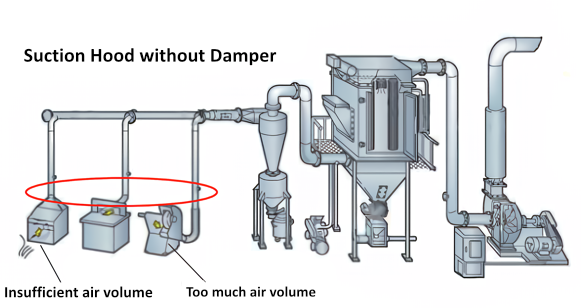
Insufficient Suction (Poor Environment & Quality Issues):
- Inlets far from the collector or with complex piping will suffer from extremely weak suction.
- Result: Dust disperses into the air, worsening the work environment. It also increases the risk of foreign material contamination in your products.
Duct Clogging (Blockages):
- If the airflow is insufficient, the air cannot maintain the necessary "transport velocity" to keep the dust moving.
- Result: Dust settles at the bottom of the ductwork, eventually clogging the pipes. This further reduces airflow, compounding the problem.
Excessive Suction at Specific Points:
- Conversely, inlets closest to the collector will suction too aggressively.
- Result: You may accidentally suck up usable raw materials (reducing yield) or generate high-pitched whistling noise pollution.
Increased System Load:
- The lack of balance forces the dust collector to operate inefficiently, potentially causing uneven wear on the motor and filters.
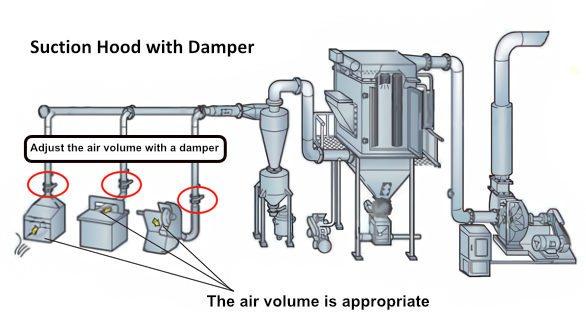
The most reliable solution is to introduce "physical control." I propose the following steps, ordered from most essential to advanced.
1. Installation of Dampers (Recommended)
This is the most fundamental and effective solution.
- Method: Retrofit slide dampers (blast gates) or butterfly dampers near each inlet hood or at branch points.
- Adjustment: The goal is not to open them all 100%. You must perform "balancing": slightly close the dampers closest to the collector (where suction is strong) to force more air to the furthest inlets (where suction is weak).
- Key Point: Use an anemometer to ensure each inlet maintains the required capture velocity (typically 15m/s to 20m/s or higher for dust).
2. Redesigning Duct Layout
-
Method: Re-engineering the pipe diameters and lengths so that resistance is naturally equal across the system. However, since this requires major construction, Solution A (Dampers) is usually the most realistic first step
◆ Solution point
-
-
Airflow is especially likely to be excessive during the initial operation. Conversely, as the filter becomes clogged over time, airflow can decrease. Therefore, airflow adjustment is necessary.
-
Select a duct diameter appropriate for the required airflow.
-
◆ Benefits
-
Adjusting hood airflow for stable operation

Our dust collector experts will answer your questions. We look forward to hearing from you about any problems with your existing dust collector or any consultations regarding new dust collectors.
